
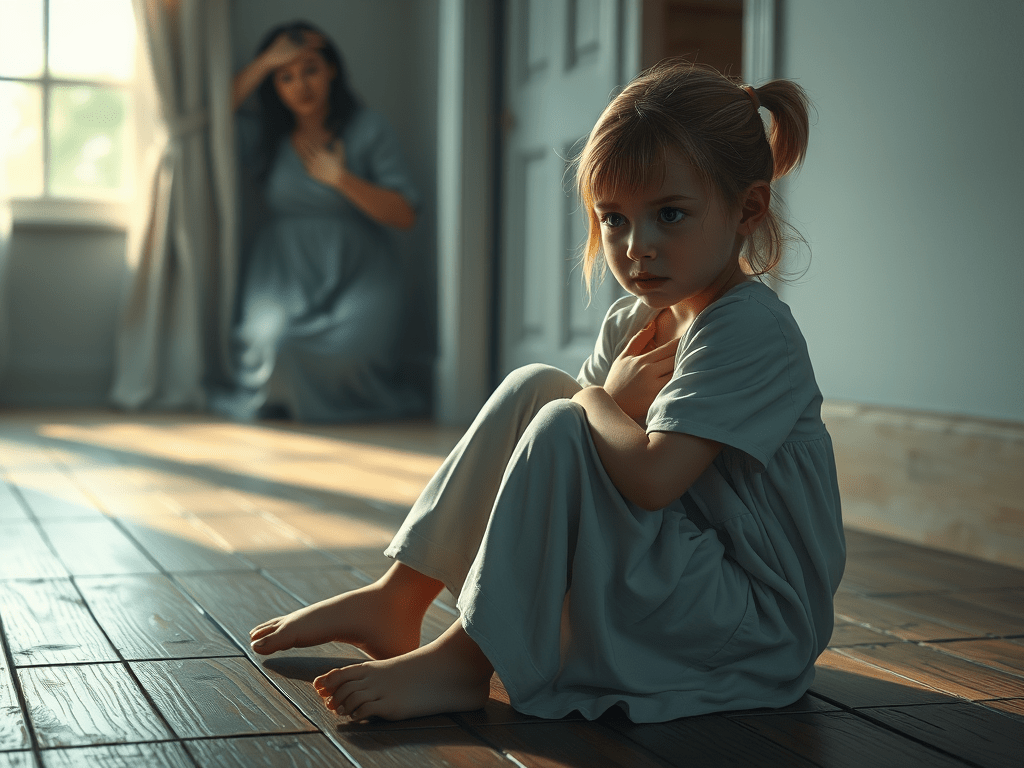
I remember the day the silence started. It was a sunny, brisk February day. Our grandparents had taken my sister and me to find sand dollars at the beach and do cartwheels in the sand. I was tired, groggy, and had sand still in my hair from the wind. I had changed into my nightgown and was bringing the brush out to Grammy for her to brush out my hair.
The Shattering Silence
My mother stopped me. She took the brush, and the world went mute. I couldn’t hear what she was saying anymore. My knees were shaking, my chest hurt, my heart was pounding in my ears, and my hands were wet. Something was terribly wrong, but her lips were still moving, her eyebrows down and angry. I remember the wood floor was cold under my knees, my hands felt sticky. Mom had just said that we were moving out of state, grandma and poppy weren’t coming; we weren’t allowed to stay. She refused to leave us here and be “called a bad mother.”
There was no sound as I crawled toward Gramma. I felt my chest heave, my throat felt sticky, my nose and eyes were leaking. I wanted to scream, ‘Don’t let her take me from you.’ But all I felt was my mother grabbing the back of my nightgown and yanking me up. She looked so mean, she wouldn’t hug me. I just wanted her to let go so Gramma could hold me. The hug never came.
The Burden of Pretending
Instead, we moved in with my father’s older sister, my aunt. She was relentless, with severe features and a meticulously kept house. She took my sister and me to lunch when the moving truck got there and told us the ‘rules.’ We were to share a room upstairs with her and my cousins, whom I had never met. I didn’t like how she chewed. She kept pulling on my hand when I would pick the string on my sleeve. She yelled all the time; her voice was shrill and cracked. It made me think all parents were angry now. She told me my hair was always a mess, but Mom wouldn’t brush it like Gramma did.
I was a burden, she didn’t care. She didn’t want to listen to me complain about the kids at school calling us the ‘Jewish twins.’ She told me to leave her alone. I would walk up the stairs, go down the small hallway, and call Gramma, crying, begging, please, please just come get me.
I was alone, so I couldn’t make friends. I called my two friends every day and told them stories about how popular we were here, and how many boys liked us! Anything but the truth. The burden of pretending was easier than the reality of being alone. The willingness to compromise myself, to accept any direction that promised connection, became my reflex. Anything to fill the emptiness.
The Cold Truth
I was 14 years old, and we moved again. In the middle of the night, Mom packed us in the van. She shoved clothes at our feet. My younger brother was crying. I couldn’t find his binky or his bottle. I was so cold. Mom turned the radio up to drown out the sound of our questions and crying.
At 15, we were in a school so small and rural there were only 40 kids in the whole graduating class. My accent was interesting; our hand-me-down name-brand clothes were accepted here. The popular girl liked my hair straightened, not curly, and put heavy makeup on my face when I got to school. I kept straightening my curls. I went to my first boat-dance, and a boy asked me to dance. He asked the popular girl for my number. She gave it to him. I felt so uncomfortable. I wasn’t sure I was ready for that, but he added me on social media before we even got back to the dock, and the popular girl said we were going on a double date tomorrow. I was already smashed in the middle of the bench seat, wearing a too-tight bikini under my camisole, and I don’t remember agreeing to the ride home. Mom wasn’t home again.
It was the week before my 16th birthday. Gramma and Poppy sold everything to move here, and I slept over whenever they could come get me. Poppy would drive me to my former partner’s house. They didn’t understand; I needed to go every weekend. Otherwise, he said he would break up with me, and if he broke up with me, who would love me?
My boyfriend ran seven miles to our house. Mom wasn’t home again. I remember sitting on the floor of the living room, watching my younger brother play with the family dog, his little chubby hand running over the black fur, and his little giggle when the dog licked his sticky fingers. My sister was in the bedroom playing a game with her friend. Then there was a banging on the door. I didn’t even get through the kitchen when my cheek burned, my nose felt hot, and my left eye was blurry. Now my younger brother was crying, the dog was barking, and my left ear was ringing. My former partner was standing in front of me, waving his phone, screaming something about a girl I knew. I had to be sleeping with her—that’s why I didn’t make sure someone brought him to my house this weekend.
Gramma came over to make dinner. She made me tea at the kitchen counter and asked what happened to my eye, which was almost swollen shut. I look at the mirror, covering a hole in the wall left when he shoved me. “I fell in the shower, Gramma.” I put two lumps of sugar and some cream in the tea. I swallowed the warm, sweet tea like the silence and shame that I had just allowed to become the language of my life.
The Final Echo
My daughter was six months old. She was crying, and I was holding her tight to my chest. My vision was spotty, my lungs were screaming for air, my throat burned, crushed by the two hands around it. The cold metal door was biting into my back. Sickly warm, sticky blood dripped from my hair onto my bare shoulder. My legs felt like bricks, kicking for purchase.
I started to feel it then: the overwhelming sense of dread and fear of dropping my baby.
I pushed my head back against the door, and I heard a crack, a yell. My body felt like being buried in the sand at the beach. For a second, I saw Gramma, and Poppy, and me as a baby in a pink hat, crawling in the sand as the water ran over my little hands. But my reality was much worse.
I remember gripping my daughter as close to me as I could, trying not to get her dirty, and dragging myself up the horribly scratchy carpet, squeaking onto the pergo floor, and pulling us into her closet. I moved her to my right arm, trying so hard to use my left hand to turn on my hidden phone. As soon as I got 9-1-1 and hit the green button, I choked on my sobs. I couldn’t even give my address. There was crashing against the closet door; it splintered. I tucked my daughter into my chest, curled over and pivoted, so my back was to the door, just as the door crashed apart.
I feel my scalp screaming as I am being dragged back through my blood, clinging onto the baby, begging someone to please hurry and finally screaming my address. But there is a crack. The phone screen is black. My daughter is screaming on my chest. I’m staring at the moon that I hung above her crib. I can’t breathe again.
There is a gun on my face. It’s hard, it’s cold, and he’s staring at me. I can’t hear anything but my daughter. I can’t feel anything but her warm body, her soft skin. I look at her blue teddy feet. I tuck her head under my chin and roll. I feel my head as if it is stuck to the carpet; I feel my hands scrape on a broken picture as my hand crunches on the glass. I scream as loud as I ever have.
I finally heard a pounding on the door. I don’t look back. I run down the stairs; I feel the cold handle of the door as I unlock it and yank.
“Please, just let us leave,” is the first thing I can say. “He has a gun,” is the next thing I scream, as I grabbed her car seat and our bag that was sitting by the door. I don’t stop, not until hands grab me, the officer, and I keep screaming, “Do not touch my baby.” I will never stop screaming, do not touch my baby.
The chaos of that moment, the fear for my daughter, was the final echo of a trauma that began over a decade ago. It was the crushing weight of the past that taught me to confuse violence with love. This, then, is the answer that I have searched for over a decade: the moment I broke the cycle was the moment I realized the chaos wasn’t home.
It took another year of fighting against a world that didn’t want to help, but eventually, my daughter and I finally just packed the car and ran. These are the bricks and tears, the silent sobs that built my biography, and the foundation of this blog. If I can leave, you can too. You can save your children, and we can all demand change.

Leave a comment